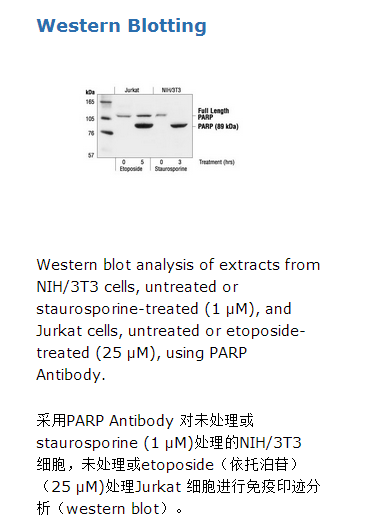
PARP Antibody detects endogenous levels of full length PARP1 (116 kDa), as well as the large fragment (89 kDa) of PARP1 resulting from caspase cleavage. The antibody does not cross-react with related proteins or other PARP isoforms.does not cross-react with related proteins or other PARP isoforms.
Source / Purification
Polyclonal antibodies are produced by immunizing animals with a synthetic peptide corresponding to the caspase cleavage site in PARP. Antibodies are purified by protein A and peptide affinity chromatography.protein A and peptide affinity chromatography.
Background
PARP, a 116 kDa nuclear poly (ADP-ribose) polymerase, appears to be involved in DNA repair in response to environmental stress (1). This protein can be cleaved by many ICE-like caspases in vitro (2,3) and is one of the main cleavage targets of caspase-3 in vivo (4,5). In human PARP, the cleavage occurs between Asp214 and Gly215, which separates the PARP amino-terminal DNA binding domain (24 kDa) from the carboxy-terminal catalytic domain (89 kDa) (2,4). PARP helps cells to maintain their viability; cleavage of PARP facilitates cellular disassembly and serves as a marker of cells undergoing apoptosis (6).


 京公网安备11010802025653 版权所有:北京逸优科技有限公司


