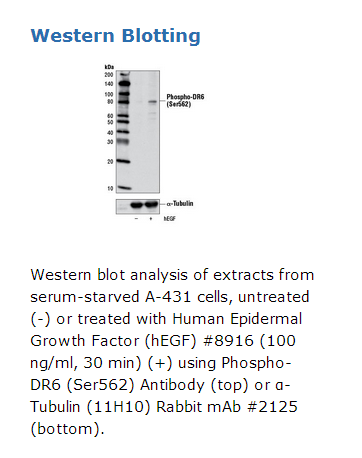
Phospho-DR6 (Ser562) Antibody recognizes endogenous levels of DR6 protein only when phosphorylated at Ser562. This antibody may recognize DR6 with dual phosphorylation at Ser562 and Ser565.
Source / Purification
Polyclonal antibodies are produced by immunizing animals with a synthetic peptide corresponding to residues surrounding Ser562 of human DR6 protein. Antibodies are purified by protein A and peptide affinity chromatography.
Background
The tumor necrosis factor receptor family, which includes TNF-RI, Fas, DR3, DR4, DR5, and DR6, plays an important role in the regulation of apoptosis in various physiological systems (1,2). The receptors are activated by a family of cytokines that include TNF, FasL, and TRAIL. They are characterized by a highly conserved extracellular region containing cysteine-rich repeats and a conserved intracellular region of about 80 amino acids termed the death domain (DD). The DD is important for transducing the death signal by recruiting other DD containing adaptor proteins (FADD, TRADD, RIP) to the death-inducing signaling complex (DISC), resulting in activation of caspases.DR6, also known as TNFRSF21, is a TNFR family member able to induce apoptosis as well as activation of NF-κB and JNK (3). Expression of DR6 is upregulated by NF-κB signaling (4). DR6 appears to play a critical role in the activation and differentiation of T and B lymphocytes (5,6). In the nervous system β-amyloid precursor protein (APP) activates DR6 to trigger neuronal degeneration (7). Phospho-DR6 (Ser562) Antibody is directed at a site that was identified at Cell Signaling Technology (CST) using PhosphoScan®, our proprietary LC-MS/MS platform for modification site discovery using an Akt substrate antibody (8). Please visit PhosphoSitePlus®, our modification site knowledgebase, at www.phosphosite.org for more information.


 京公网安备11010802025653 版权所有:北京逸优科技有限公司


