Species predicted to react based on 100% sequence homology:Monkey
Specificity / Sensitivity
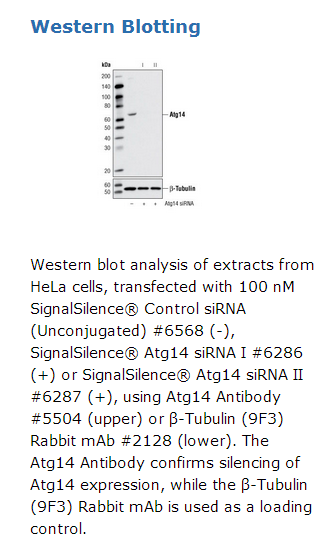
Atg14 Antibody detects endogenous levels of total Atg14 protein.
Source / Purification
Polyclonal antibodies were prepared from animals immunized with a synthetic peptide corresponding to a region surrounding Val215 of human Atg14. Antibodies were purified by protein A and peptide affinity chromatography.
Background
Autophagy is a catabolic process for the autophagosomic-lysosomal degradation of bulk cytoplasmic contents (1,2). Autophagy is generally activated by conditions of nutrient deprivation but is also associated with a number of physiological processes including development, differentiation, neurodegeneration, infection, and cancer (3). The molecular machinery of autophagy was largely discovered in yeast and is directed by a number of autophagy-related (Atg) genes.These proteins are involved in the formation of autophagosomes, which are cytoplasmic vacuoles that are delivered to lysosomes for degradation. The class III type phosphoinositide 3-kinase (PI3K) Vps34 regulates vacuolar trafficking and autophagy (4,5). Multiple proteins associate with Vsp34, including p105/Vsp15, Beclin-1, UVRAG, Atg14, and Rubicon (6-12). Atg14L and Rubicon were identified based on their ability to bind to Beclin-1 and participate in unique complexes with opposing functions (9-12). Rubicon, which localizes to the endosome and lysosome, inhibits Vps34 lipid kinase activity; knockdown of Rubicon enhances autophagy and endocytic trafficking (11,12). In contrast, Atg14L localizes to autophagosomes, isolation membranes, and ER and can enhance Vps34 activity. Knockdown of Atg14L inhibits starvation-induced autophagy (11,12).


 京公网安备11010802025653 版权所有:北京逸优科技有限公司


