Species predicted to react based on 100% sequence homology:Mouse, Rat, Monkey, Dog
Specificity / Sensitivity
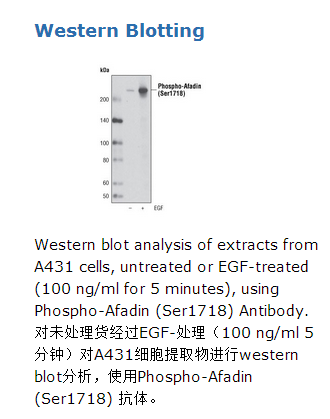
Phospho-Afadin (Ser1718) Antibody detects endogenous levels of l-afadin protein only when phosphorylated at serine 1718.
Source / Purification
Polyclonal antibodies are produced by immunizing animals with a synthetic phosphopeptide corresponding to residues surrounding Ser1718 of human afadin. Antibodies are purified using protein A and peptide affinity chromatography.
Background
In multicellular organisms, intercellular junctions play essential roles in tissue integrity and maintenance of cell polarity. Tight junctions (TJs) form a continuous barrier to fluids across the epithelium and endothelium (reviewed in 1). Adherens junctions (AJs) are dynamic structures that form cell-cell contacts linking cells into a continuous sheet (reviewed in 2). The actin filament-binding protein, Afadin, binds to nectin forming a connection to the action cytoskeleton (3). AJs are formed when nectin assembles cadherin at the cell-cell adhesion site and these junctions are then involved in the formation and maintenance of TJs (4, 5). Afadin has two splice variants: l-afadin, which is ubiquitously expressed, and s-afadin, which is expressed predominantly in neural tissue. s-Afadin is a shorter form lacking one of the three proline-rich regions found in l-afadin as well the carboxyl-terminal F-actin binding region (6). Human s-afadin is identical to AF-6, the ALL-1 fusion partner involved in acute myeloid leukemias (7). Recent work has also shown that afadin is involved in controlling the directionality of cell movement when it is localized at the leading edge of moving cells (8, 9).
Phospho-Afadin (Ser1718) Antibody is directed at a site that was identified at Cell Signaling Technology (CST) using PhosphoScan®, CST's LC-MS/MS platform for modification site discovery. Phosphorylation at Ser1718 was discovered using an Akt substrate antibody. Please visit PhosphoSitePlus®, CST's modification site knowledgebase, at www.phosphosite.org for more information.
注意事项:
Storage: Supplied in 10 mM sodium HEPES (pH 7.5), 150 mM
NaCl, 100 µg/ml BSA and 50% glycerol. Store at –20°C.
Do not aliquot the antibody


 京公网安备11010802025653 版权所有:北京逸优科技有限公司


