Species predicted to react based on 100% sequence homology:Horse
Specificity / Sensitivity
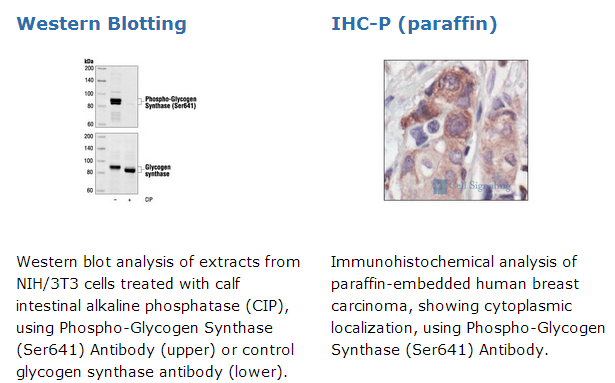
Phospho-Glycogen Synthase (Ser641) Antibody detects endogenous levels of both muscle and liver isoforms of glycogen synthase only when phosphorylated at serine 640 or 641 of the muscle and liver isoforms, respectively.
Source / Purification
Polyclonal antibodies are produced by immunizing animals with a synthetic phosphopeptide corresponding to residues surrounding Ser641 of human liver glycogen synthase. Antibodies are purified by protein A and peptide affinity chromatography.
Background
Glycogen synthase (GS) is a key enzyme in the regulation of glycogen synthesis. There are two main isoforms of mammalian GS: the muscle and the liver isoform (1-2). Muscle GS is expressed in several tissues, and liver GS appears to be tissue specific (3). GS is regulated by multi-site phosphorylation and by the binding of allosteric ligands. Phosphorylation leads to inactivation of GS, but activity is restored by the binding of the allosteric activator glucose-6-phosphate, which induces its dephosphorylation and activation (4).Ser641 is one of the most important phosphorylation sites for the regulation of glycogen synthase (5).


 京公网安备11010802025653 版权所有:北京逸优科技有限公司


