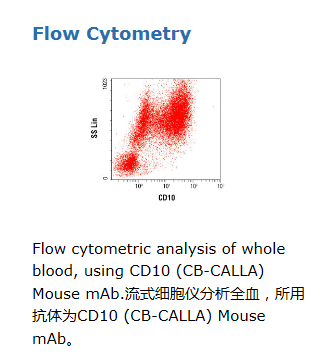
CD10 (CB-CALLA) Mouse mAb detects endogenous levels of CD10.
Source / Purification
Monoclonal antibody is produced by immunizing BALB/c mice with CALLA cells.
Background
CD10 (CALLA or neprilysin) was identified as a marker for leukemic cells in children with acute lymphoblastic leukemia and belongs to a family of exoenzymes that include aminopeptidase A, N and dipeptidylpeptidase IV (1-2). CD10 is a transmembrane type II molecule and functions as a metallo-peptidase requiring zinc. Specifically, CD10 cleaves 1-3 amino-terminal amino acids from peptides with a preference for neutral amino acids (valine, iso-leucine, phenylalanine, leucine or alanine) (2). The CD10 antigen is expressed by immature and by germinal center B cells, by granulocytes and by acute B-cell lymphoblastic leukemia cells. Therefore, CD10 appears to be involved in late stage regulation of hematopoietic cells (3).
Storage:Supplied in 10 mM sodium HEPES (pH 7.5), 150 mM NaCl, 100 µg/ml BSA, 50% glycerol and less than 0.02% sodium azide. Store at –20°C. Do not aliquot the antibody.