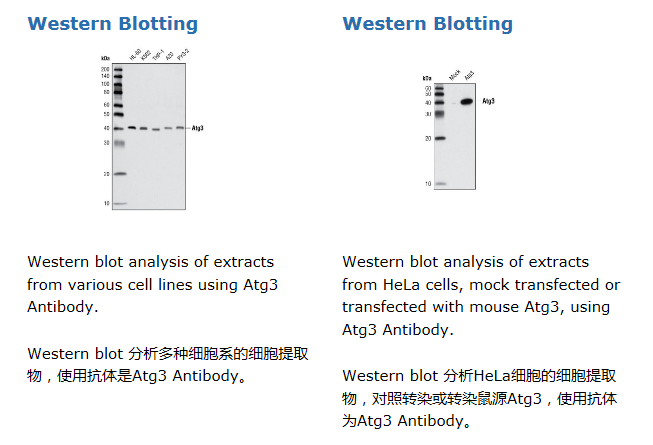
Atg3 Antibody detects endogenous levels of total Atg3 protein.
Source / Purification
Polyclonal antibodies are produced by immunizing animals with a synthetic peptide corresponding to residues near the amino terminus of Atg3. Antibodies are purified by protein A and peptide affinity chromatography.
Background
Autophagy is a catabolic process for the autophagosomic-lysosomal degradation of bulk cytoplasmic contents (1). The molecular machinery of autophagy was largely discovered in yeast and referred to as autophagy-related genes (Atg). Formation of the autophagic vesicles involves two ubiquitin-like conjugation systems, Atg12-Atg5 and Atg8-phosphatidylethanolamine (Atg8-PE), which are essential for autophagy and widely conserved in eukaryotes (2). There are at least three Atg8 homologs in mammalian cells, GATE-16, GABARAP, and LC3, that are conjugated by lipids (3,4). Lipid conjugation of Atg8 and its mammalian homologs requires Atg3 (Apg3p/Aut1p in yeast), an ubiquitously expressed E2-like enzyme (5-7). Following C-terminal cleavage by the cysteine protease Atg4, the exposed glycine residue of Atg8 binds to the E1-like enzyme Atg7, is transferred to Atg3, and then conjugated to phophatidylethanolamine. Atg3-deficient mice die within 1 day after birth and are completely defective for the conjugation of Atg8 homlogs and autophagome formation (8).


 京公网安备11010802025653 版权所有:北京逸优科技有限公司


