Species predicted to react based on 100% sequence homology: Monkey
Specificity / Sensitivity
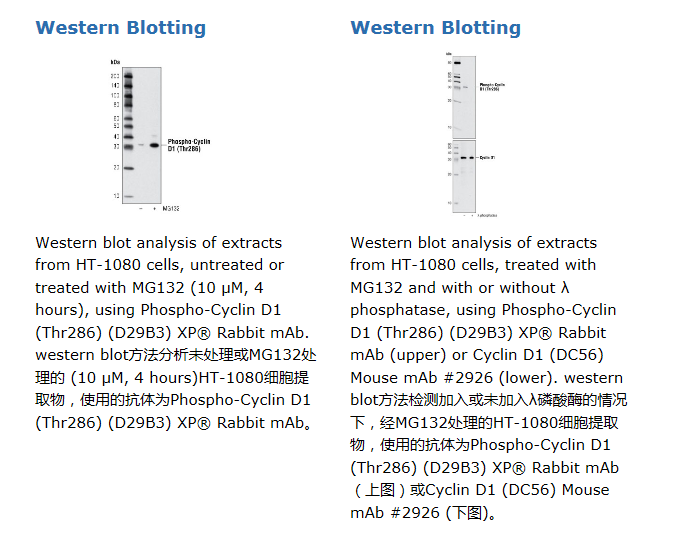
Phospho-Cyclin D1 (Thr286) (D29B3) XP® Rabbit mAb detects endogenous levels of cyclin D1 only when phosphorylated at Thr286. The antibody does not cross-react with other cyclin D family members.
Source / Purification
Monoclonal antibody is produced by immunizing animals with a synthetic phosphopeptide corresponding to residues surrounding Thr286 of cyclin D1.
Background
Activity of the cyclin-dependent kinases CDK4 and CDK6 is regulated by T-loop phosphorylation, by the abundance of their cyclin partners (the D-type cyclins), and by association with CDK inhibitors of the Cip/Kip or INK family of proteins (1). The inactive ternary complex of cyclin D/CDK4 and p27 Kip1 requires extracellular mitogenic stimuli for the release and degradation of p27 concomitant with a rise in cyclin D levels to effect progression through the restriction point and pRb-dependent entry into S-phase (2). The active complex of cyclin D/CDK4 targets the retinoblastoma protein for phosphorylation, allowing the release of E2F transcription factors that activate G1/S-phase gene expression (3). Levels of cyclin D protein drop upon withdrawal of growth factors through downregulation of its protein expression and through phosphorylation-dependent degradation (4).
Aberrant expression of cyclin D1 is associated with many forms of cancer, including B cell lymphomas. Gene translocation or amplification of the cyclin D1 gene can directly contribute to oncogenesis (2). Cyclin D1 also plays a critical role in mammary tissue maturation (5). Phosphorylation of cyclin D1 at Thr286 by glycogen synthase kinase 3β (4) or through the Ras/Raf/MEK/MAPK pathway (6) enhances its ubiquitination and proteasomal degradation.
Storage:Supplied in 10 mM sodium HEPES (pH 7.5), 150 mM NaCl, 100 µg/ml BSA, 50% glycerol and less than 0.02% sodium azide. Store at –20°C. Do not aliquot the antibody.