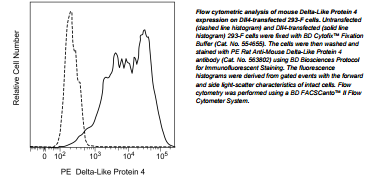
The 9A1.5 monoclonal antibody specifically binds to an extracellular domain of Delta-Like Protein 4 that is encoded by the Dll4 gene. Delta-Like Protein 4 is a type 1 transmembrane glycoprotein that is also known as Delta-like 4, Delta-like Ligand 4, Delta4 and DL4. It is a member of the Delta/Serrate/Jagged Family of Notch ligands. Notch ligands are classified by the presence of specific structural motifs including an N-terminal Delta-Serrate-LAG-2 (DSL) domain necessary for Notch binding, EGF repeats, and the DOS domain (a specialized EGF repeat). The Notch family of transmembrane receptors and their ligands control cell-fate "decisions" during the development of many organs in a wide variety of animal species. Delta-Like Protein 4 activates cellular signaling pathways by binding to Notch1 and Notch4 receptors. It is involved in embryonic vascular development and tumor angiogenesis, and is induced by vascular endothelial growth factor (VEGF)-A and hypoxia. Delta-Like Protein 4 and Notch receptor signaling are also intimately involved in the regulation of innate and adaptive immunity. Delta-Like Protein 4 is highly expressed by cortical thymic epithelial cells (TEC). Interaction between Delta-Like Protein 4-positive TEC and Notch1 expressed by T cell precursors drives T cell lineage commitment, expansion and maturation within the thymus. Delta-Like Protein 4 is also expressed by dendritic cells and plays a role in peripheral T helper cell differentiation. Blocking of Delta-Like Protein 4 and Notch receptor interactions serves to diminish autoimmune diseases in mouse model systems.
原厂资料:
注意事项:
1.Since applications vary, each investigator should titrate the reagent to obtain optimal results.
2.Caution: Sodium azide yields highly toxic hydrazoic acid under acidic conditions. Dilute azide compounds in running water before discarding to avoid accumulation of potentially explosive deposits in plumbing.
3.Store undiluted at 4°C and protected from prolonged exposure to light. Do not freeze.
4.The monoclonal antibody was purified from tissue culture supernatant or ascites by affinity chromatography.
5.The antibody was conjugated with R-PE under optimum conditions, and unconjugated antibody and free PE were removed.


 京公网安备11010802025653 版权所有:北京逸优科技有限公司


