描述:
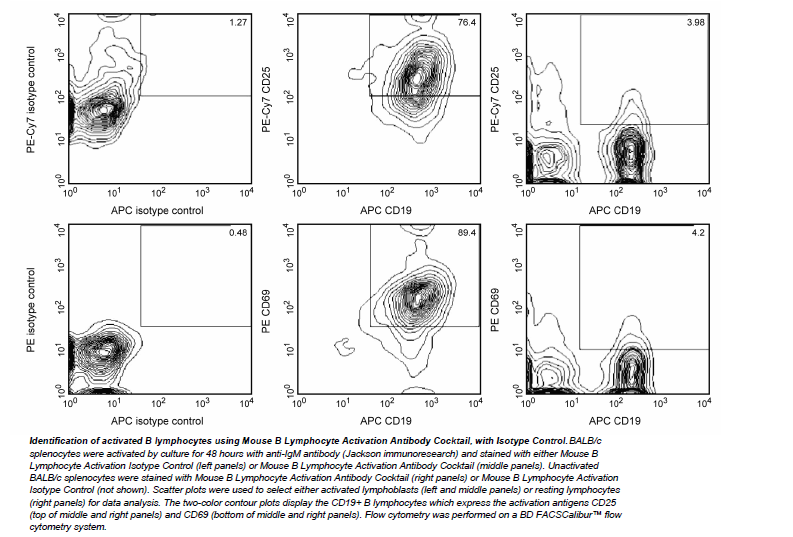
The Mouse B Lymphocyte Activation Antibody Cocktail is a three-color reagent designed to identify major subsets of B lymphocytes by direct
immunofluorescent staining with flow cytometric analysis. The PC61 antibody reacts with CD25, the low-affinity IL-2 Receptor achain
(IL-2Rα, p55) expressed on activated T and B lymphocytes from all mouse strains tested. CD25 is also found on some developing B cells in
the bone marrow, early developing T cells in the thymus, peripheral CD4+ regulatory T (Treg) cells, and dendritic cells. The H1.2F3 antibody
reacts with CD69 (Very Early Activation antigen). Its expression is rapidly induced upon activation of lymphocytes (T, B, NK, and NK-T
cells) neutrophils, and macrophages. CD69 is also expressed on thymocytes that are undergoing positive selection. The 1D3 antibody reacts
with CD19, a B lymphocyte-lineage differentiation antigen that is expressed throughout B-lymphocyte development from the pro-B cell
through the mature B-cell stages. Terminally differentiated plasma cells do not express CD19. The three antibodies have been titrated and
pre-diluted, mixed together, and formulated for optimal staining performance. The Mouse B Lymphocyte Activation Isotype Control contains
equivalent concentrations of fluorochrome- and isotype-matched negative-control immunoglobulin.
The use of three different fluorochromes for the labeling of the three different antibodies permits the recognition of each of the three antigens
on each cell in a sample. The expression of the three antigens identifies activated B lymphocytes. Additional fluorochrome-labeled reagents
may be combined with the Mouse B Lymphocyte Activation Antibody Cocktail, and the Mouse B Lymphocyte Activation Isotype Control, to
further characterize activated B-cell subpopulations.
注意事项:
1.This reagent has been pre-diluted for use at the recommended Volume per Test. We typically use 1 × 10^6 cells in a 100-μl experimental
sample (a test).
2.Since applications vary, each investigator should titrate the reagent to obtain optimal results..
3.Caution: Sodium azide yields highly toxic hydrazoic acid under acidic conditions. Dilute azide compounds in running water before
discarding to avoid accumulation of potentially explosive deposits in plumbing.
4.Store undiluted at 4°C and protected from prolonged exposure to light. Do not freeze.


 京公网安备11010802025653 版权所有:北京逸优科技有限公司


