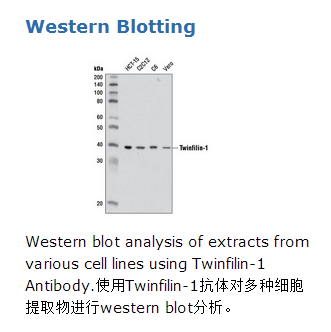
Twinfilin-1 Antibody recognizes endogenous levels of total twinfilin-1 protein.
Source / Purification
Polyclonal antibodies are produced by immunizing animals with a synthetic peptide corresponding to residues near the carboxy terminus of human twinfilin-1 protein. Antibodies are purified by protein A and peptide affinity chromatography.
Background
Twinfilin is an actin monomer-binding protein found in all eukaryotes (1). Mammals have three isoforms. Twinfilin-1 and twinfilin-2a are expressed in most non-muscle cell types, whereas twinfilin-2b is the main isoform in adult heart and skeletal muscle (2). Twinfilins are composed of two ADF-homology domains connected by a 30 kDa linker region. All twinfilins have been shown to form a 1:1 complex with G-actin, but not F-actin (reviewed in 3). Twinfilin-1 was originally known as A6 protein tyrosine kinase and thought to be part of a novel class of protein kinases. However, the protein was renamed after further studies showed no evidence of tyrosine kinase activity (4). Twinfilin-1 helps to prevent the actin filament assembly by forming a complex with actin monomers and, in mammals, has been shown to cap the filament barbed ends. It has been suggested that this regulates cell motility (5). Suppression of twinfilin-1 has also been shown to slow lymphoma cell migration to lymph nodes (6).
注意事项:
Storage: Supplied in 10 mM sodium HEPES (pH 7.5), 150 mM
NaCl, 100 µg/ml BSA and 50% glycerol. Store at –20°C.
Do not aliquot the antibody


 京公网安备11010802025653 版权所有:北京逸优科技有限公司


